

Building a web-first agent evaluation platform
How a single developer built a production-ready platform for systematically evaluating AI agents through simulated conversations — from monorepo scaffold to browser-only compliance in 10 days.
| Detail | Value |
|---|---|
| Project | Agent Evaluation Platform |
| Timeline | 10-Day MVP Sprint |
| Architecture | Browser-First Serverless |
| Scope | 27K Lines TypeScript |
The Problem
AI agents that handle customer support, answer questions, and perform tasks need systematic evaluation. As agents grow in number and complexity, manual testing breaks down. You need a way to:
- Replay real conversations against agents to detect regressions
- Simulate new conversations using LLMs as stand-in users
- Score agent responses automatically using metrics like trajectory matching, task completion, and faithfulness
- Track performance over time across agent versions and configuration changes
The goal: build a platform that runs hundreds of evaluation sessions with reproducible results — replacing ad-hoc manual testing with a systematic, automated pipeline.
Note: Manual testing was insufficient. Agents needed evaluation at scale — across hundreds of conversation sessions, with reproducible results and quantitative metrics.
Architecture Decisions
Three foundational decisions shaped everything that followed: the monorepo structure, the data layer choice, and the serverless deployment target.
Monorepo with Turborepo
The project adopted a pnpm + Turborepo monorepo from day one, splitting concerns across focused packages:
Monorepo Package Structure
| Package | Purpose | Lines |
|---|---|---|
| Web App | Next.js application, UI, state management | 12,257 |
| Agent Simulator | Core types, adapters, data I/O | 3,774 |
| Profile Config | Hierarchical profile management | 2,596 |
| Shared UI | Component library | 2,440 |
| Agent Evaluation | Metrics framework, LLM judge | 1,884 |
| User Simulator | LLM-based user simulation providers | 1,636 |
| Agent Orchestration | Browser simulation client, chunking | 1,508 |
| LLM Providers | Provider configuration schemas | 694 |
The monorepo allowed sharing TypeScript types and utilities between packages while maintaining clear boundaries. Build caching reduced incremental build times to under 1 second.
Spreadsheets as the Data Layer
Rather than building a database backend, the project chose Google Sheets as both input and output:
- Input: Users define test datasets as structured sheets (session ID, event type, message text)
- Output: Simulation results, metric scores, and agent snapshots are written back to the same spreadsheet
- Tracking: Transient tracking sheets coordinate chunked processing
Why Spreadsheets?: The target users — agent builders and QA engineers — already lived in spreadsheets. Using Sheets as the data layer eliminated the need for a database, admin UI, or data import/export features. A template system auto-creates properly formatted spreadsheets with seed data.
- Provision and maintain a database
- Build an admin UI for data management
- Create import/export pipelines
- Manage database migrations
- Build access control for data
Result: Weeks of infrastructure work before first evaluation runs.
- Users create test data in familiar spreadsheets
- Results appear in the same spreadsheet
- No infrastructure to manage
- Template system bootstraps new datasets
- Sharing via standard Sheets permissions
Result: Users running evaluations on day one.
Trade-offs discovered along the way:
- No transactional guarantees — concurrent chunk writes can race
- Column-position parsing instead of header-name parsing caused fragility
- Metric merge logic required 200+ lines of fragile row-index tracking
- Row limits were hardcoded and discovered late
Compliance by Design
A critical early decision: ensure sensitive data (customer conversations, support transcripts) never touches the server infrastructure. This wasn’t a feature bolted on later — it was an architectural constraint from the start.
The Browser-Only Architecture
- Simulation runs entirely in the browser — the client orchestrates everything
- API routes are “dumb proxies” — they forward requests with auth headers but never inspect conversation data
- Encryption at rest — OAuth tokens and credentials use AES-256-CBC encrypted localStorage
This was implemented as a dedicated 4-phase branch with 8 commits, transforming the architecture from server-executed to browser-executed simulation.
Before vs. After: Data Flow
| Aspect | Server-Side (Before) | Browser-Only (After) |
|---|---|---|
| Simulation execution | API routes load data, run engine, save results | Browser loads data via proxy, runs engine client-side |
| Conversation data | Passes through server, stored in memory | Never leaves browser memory |
| Credentials | Server-side environment variables | AES-256-CBC encrypted localStorage |
| API calls | Direct from server | Routed through stateless proxy endpoints |
| Compliance posture | Requires server-side audit trail | Compliant by architecture |
War Story: The browser-only refactor touched every layer of the stack. It required creating a browser-compatible HTTP client interface, removing all filesystem and environment variable dependencies from the core library, building a proxy client that routes all API calls through relay endpoints, and handling Date serialization across the browser-server boundary. Eight commits over a single day — one of the most intense refactoring efforts in the project.
Tip: The “dumb proxy” pattern is worth adopting early. When your API routes never inspect payload content, compliance becomes an architectural property rather than an audit requirement. The proxy forwards, it never reads.
The Evaluation Framework
Seven metrics were implemented, each following a common interface. Five use an LLM as judge for nuanced evaluation; two are calculated from request metadata.
Evaluation Metrics
| Metric | Type | Method | What It Measures |
|---|---|---|---|
| E2E Score | Session | LLM Judge | Compares simulated trajectory against reference conversation |
| Task Completion | Turn | LLM Judge | Did the agent answer the user’s question? |
| Faithfulness | Turn | LLM Judge | Are responses grounded in available knowledge? |
| Clarifications | Session | LLM Judge | Were appropriate clarifying questions asked? |
| Output Format | Session | LLM Judge | Response formatting quality |
| Latency Score | Session | Calculated | Time-to-first-token performance |
| Max Turn Duration | Session | Calculated | Identifies the slowest turn in a conversation |
LLM-as-Judge
Five of seven metrics use an LLM to evaluate agent quality. A shared judge abstraction provides structured prompt-to-score evaluation: the judge receives the conversation context and a rubric, then returns a numeric score with an explanation. This enabled nuanced scoring that rule-based systems couldn’t achieve.
Turn-Level Innovation
The most significant metric design decision was supporting per-turn evaluation in multi-turn conversations. Rather than only scoring sessions as a whole, the framework evaluates each individual Q&A pair. This was critical for identifying which specific questions an agent struggles with — not just that it struggled somewhere.
The Hardest Problem: Merging per-turn evaluation scores back into the correct spreadsheet rows was the most complex challenge. The flow: simulation writes results (each turn = one row), evaluation runs metrics on each AI response, scores must land on the exact row of the AI message they evaluate. This required reconstructing turn indices from flattened sheet rows, handling multiple output formats, and preserving metadata across the merge. The solution spans ~200 lines and required 6 bug-fix commits over 3 days.
Serverless Constraints
Deploying on a serverless platform (Vercel) introduced constraints that shaped the runtime architecture: no filesystem, execution timeouts, and shared-process concurrency risks.
Chunked Processing
Running 500+ simulation sessions sequentially would exceed any serverless timeout. The solution: a smart chunking algorithm that targets 80% of the platform’s execution limit.
- Each chunk is sized to complete within the timeout
- A tracking sheet coordinates chunk progress for fault tolerance
- Failed chunks retry independently
- Results accumulate incrementally in the output sheet
- All tracking is in-memory — no filesystem operations
Adaptive Rate Limiting
External APIs have strict rate limits. Parallel execution triggers 429 errors. The rate limiter adapts in real time:
Rate Limiting Strategy
| Remaining Quota | Delay | Concurrency |
|---|---|---|
| > 50% | 100ms | 2 concurrent |
| 10–50% | Progressive increase | 2 concurrent |
| < 10% | Up to 60s | 1 concurrent |
| 0% | Wait for Retry-After | Paused |
A minimum 300ms delay between requests provides burst protection regardless of quota. The rate limit tracker singleton monitors response headers on every request.
OAuth Token Management
OAuth tokens expire during long simulation runs. The solution uses proactive refresh (5-minute buffer before expiry), a background keep-alive interval, concurrent refresh protection (preventing duplicate simultaneous refresh requests), and graceful degradation — if refresh fails but the token is still valid, it keeps working; if expired, it clears and prompts re-authentication.
Development Velocity
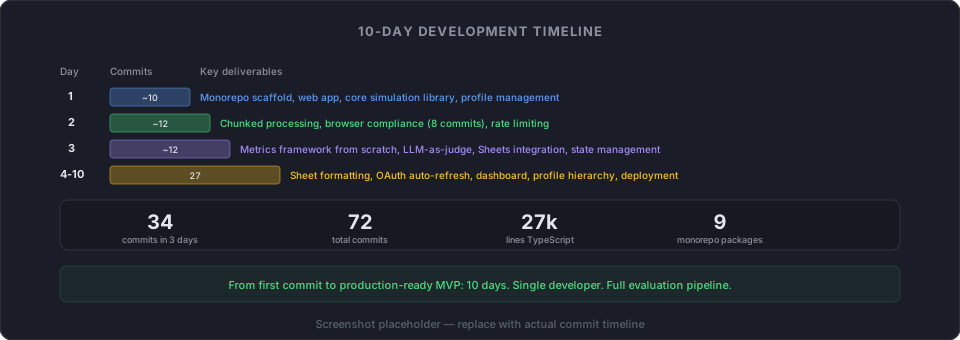
The platform went from first commit to production-ready MVP in 10 days, built by a single developer.
The First 3 Days
Day 1: Monorepo scaffold with build tooling, web application shell, core simulation library, and multi-profile management.
Day 2: Two major features — chunked processing with tracking sheets for fault tolerance, and the entire browser-only compliance refactor (8 commits). Plus adaptive rate limiting.
Day 3: The entire metrics evaluation framework built from scratch — 20 commits in a single day. TypeScript metrics interfaces, LLM-as-judge integration, E2E and task completion metrics, turn-level evaluation, Sheets integration for results, state management, profile management with encrypted storage, and configurable API endpoints.
Post-Sprint Stabilization
After the initial 10-day sprint, development shifted to maintenance and polish: formatting abstractions, latency calculations, OAuth improvements, hierarchical profile architecture, dashboard visualization, and deployment fixes. Five months later, a major cleanup removed the CLI package and all filesystem-dependent code — deleting 11,000 lines while preserving all web functionality.
Foundation
Days 1-3. 34 commits covering the monorepo, web app, simulation engine, browser compliance, chunked processing, rate limiting, and the metrics framework.
Polish
Days 4-10. Sheet formatting, OAuth auto-refresh, dashboard trends, hierarchical profiles, deployment pipeline, and production hardening.
Refactor
Month 5. Web-first cleanup removed CLI and filesystem dependencies while preserving web functionality.
Iteration Log
Each phase revealed new constraints and forced architectural pivots.
Monorepo scaffold and core library
The monorepo had clear package boundaries from day one, keeping types, adapters, and evaluation logic isolated for later refactors.
Browser-only compliance refactor
The architecture moved from server-executed to browser-executed simulation in a single day, keeping API routes simple and auditable.
Turn-level metric merging
Merging per-turn scores into the correct spreadsheet rows exposed brittle row reconstruction logic and multiple follow-up fixes.
Column-position parsing
Index-based spreadsheet parsing caused silent corruption when columns moved, making header-based parsing the stronger contract.
LLM-as-judge metrics
LLM judging enabled nuanced response quality scoring, and the shared metric interface made new metrics straightforward to add.
Adaptive rate limiting
Real-time rate-limit tracking with progressive backoff turned repeated 429 failures into sustained batch throughput.
Web-first refactor
The unused CLI and filesystem paths were removed after web usage became the clear product direction.
Takeaways
Meet users where they already work
Spreadsheets were not elegant, but they eliminated weeks of infrastructure work and let users start evaluations immediately.
Compliance is an architecture decision
The browser-only proxy pattern meant sensitive data handling was solved by design instead of added later as an audit project.
LLM-as-judge unlocks evaluation at scale
Rule-based metrics catch format and timing, while LLM judging assesses answer quality, faithfulness, and clarification behavior.
Monorepo boundaries pay off at refactor time
Package isolation made the web-first cleanup safe because core types, adapters, and evaluation logic were already separated.
Ship fast, then refine the hardest logic
A working end-to-end flow created the feedback loop needed to discover and fix the fragile metric merge path.
Serverless constraints are design constraints
Timeouts, filesystem limits, and shared-process risks pushed the system toward chunked processing and explicit recovery paths.
The Bigger Picture: This platform started as a need to test AI agents systematically. It became something broader: a framework for understanding agent behavior at scale. When you can replay hundreds of conversations, score each turn, and track performance across versions, you move from “does the agent work?” to “where exactly does it fail, and is it getting better?” That shift — from anecdotal to systematic — is what makes evaluation infrastructure worth building early.
Tip: If you’re building AI agents, invest in evaluation infrastructure early. The cost of building it is measured in days. The cost of not having it is measured in regressions you don’t catch, quality problems you can’t quantify, and confidence you can’t earn.